Monday, October 19, 2009

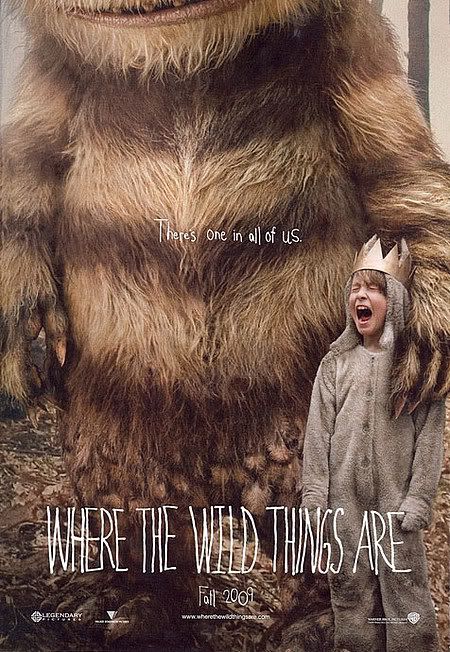
Where the Wild Things Are


It's a book with 40 pages and 10 sentences. Maurice Sendak wrote it in the 60's to a heavily mixed reception until it eventually became an established classic and a hallmark of childrens literature. Given the brevity of the material and the state of basically all film adaptations of storybook classics it's amazing that a workable 90 minute movie could be lifted from "Where the Wild Things Are." Lucky for us, Maurice Sendak isn't your normal kids author and Spike Jonze isn't your normal film director.

Aside from the animated version from the 70's (which clocked in at a staggering seven minutes) a full length feature seemed not only a generally bad idea, but seemingly implausible without the contrivances of "back story" and inflated, heavy handed thematics (Ron Howard's The Grinch comes to mind...) Then in steps independent visionary director, Spike Jonze (Being John Malkovich and Adaptation,) having struck up a genuine friendship with Maurice, took the project in an unexpected and daring direction. With Sendak's blessing to "do whatever you want with it," Jonze teamed up with author Dave Eggers (A Heartbreaking Work of Staggering Genius and this year's indie hit Away We Go) to bring out the thematic importance of not only what the book is about, but what it truly means to those that have enjoyed it for generations.

As the story goes, Max, adorned in his wolf costume, is an unruly child that is sent to bed without any supper after causing more mischief than his mother is willing to deal with. Max creates a fantasy world in his bedroom and sails to the land of the "Wild Things" and becomes their king. All the elements of the book are prominently featured (even down the the opening, pre-credits sequence in which a rambunctious Max chases his pet dog with a fork.) The expansions on the material consist of exploring the reasoning for Max's behavior. What causes him to act out? Why does he feel the need to escape? What ARE the Wild Things, realistically and to Max? The film meets Max as a normal kid with an overactive imagination. His parents are divorced and his sister is too old to be his friend any more. This is a child dealing with feelings and emotions he doesn't even understand yet, let alone knows how to deal with on any real level. Therein, whether his trip to the land of the Wild Things is real or not, it's an internalization and a personal mirror for Max to work through his feelings.

Each of the Wild Things represents a piece of Max and at the same time, pieces of the opening 1o minutes are either revisited or presented in a new light during Max's visit. The lead creature, Carol (voiced amazingly by Tony Soprano himself, James Gandolfini) is the closest representation of Max, and ultimately becomes his best friend. Ira (Forrest Whitaker) plays to Max's creative side and his island partner, Judith (Catherine O'Hara) sometimes represents Max's feelings on his older sister. KW (Six Feet Under's Lauren Ambrose) is the closest creature to representing the mother figure and the catalyst for many of the emotional squabbles. There are no heavy handed morals, or extensive speeches that come out and say all the lessons presented in the contained material, these are left for interpretation by the viewer.

Max Records, the breakout star as the aptly named Max, puts on the most genuine and honest performance of any child character ever seen on film. When I say Max is a genuine little kid, he IS a REAL little kid. He's not the wise-beyond-his-years, prodigal child that speaks like an adult that we see in every other kids movie. He thinks and speaks like a REAL little kid. He moves like a REAL little kid. His logic is mired in the trappings of a REAL kid's imagination and that's why it works so well. While some of the more intricate ideals in Where the Wild Things Are may not be apparent to some children, they should be able to at least relate to Max on a fairly personal level (given they've got the capacity for at least some imagination.) Catherine Keener makes a brief but notable appearance as Max's tired and exasperated mother. She does a wonderful job of evoking sympathy while standing in the way of Max's journey.

Where the Wild Things Are sets the bar pretty high for a family film. It doesn't talk down to the audience, but operates on the fact that while you may not know what you're feeling during or afterward, you genuinely felt something. It's there to let us know, it's ok to feel scared and sad sometimes, even if we don't know why or how to fix it. These are the things that make us human and these are the things we need to come to understand when it comes to growing up. And growing up is ok, but it's also ok to keep that inner child on standby because you should never have to take everything so seriously.

Friday, October 16, 2009

Inglourious Basterds


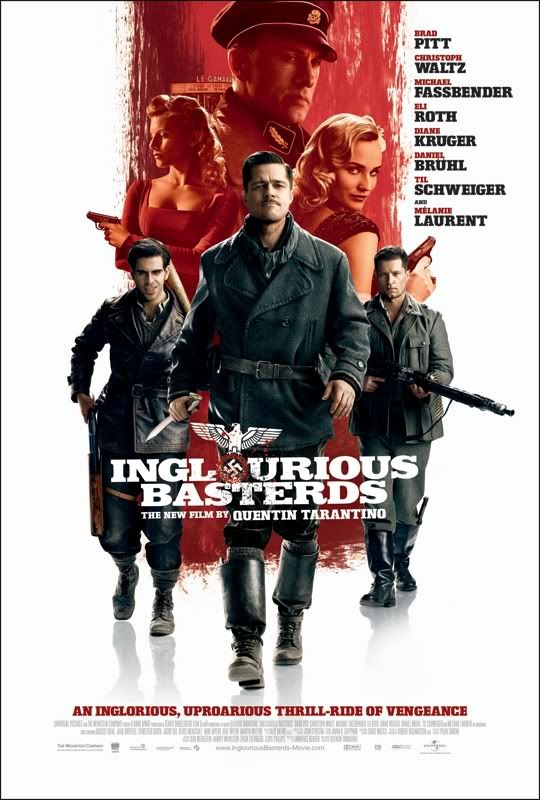
Quentin Tarantino likes to take his time between films. He'd originally announced the concept for Inglorious Bastards shortly after Jackie Brown (and the advent of the World Wide Web) though details were sparse, set to star then Tarantino favorite Michael Madsen and citing World War II and French Jewish Nazi Killers, the project was seemingly forgotten in the wake of the looming Kill Bill rumor mill. Now, 10 years later, Inglourious Basterds (misspelling intentional) finally sees the light of day.

The first thing to be aware of going in is that this is a Quentin Tarantino movie. There will be lots of dialog. Excessive amounts of it, actually, but this has always been Tarantino's strong suit. Each series of dialogs and monologues has such a specific tone and pace that the building tension is impossible to look away from. Not to mention that every payoff is exhiliratingly poignant (and inexcusably bad ass in only a way Quentin can sell it.) His structure is set up like a more deeply connected Pulp Fiction. Each act serving as a specific chapter (with chapter titles preceding each) that all collide into a beautifully chaotic final sequence that will get the vengeance blood pumping straight through your cerebral cortex.

Using his multiple narrative style, "Basterds" bounces from Lt. Aldo Raine and his band of merry nazi scalpers to the plight of a Jewish refugee operating an independent movie theater in German occupied France and ties them all together with a British top secret operation set on turning the tables of WWII. On the other side of the fence is S.S. Col. Hans Landa and Pvt. turned actor Frederick Zoller in their attempts to promote the Third Reich and defuse the Basterds proverbial death march.

Though the cast went through a roller coaster of changes up until filming began, Tarantino couldn't have assembled a better set of actors for his latest work. Leading the pack of "Basterds," as they're christened, is of course Brad Pitt. While Lt. Aldo Raine may not necessarily be the best performance of his career, it is definitely one of the most entertaining. His thick southern Tennessee accent provides hearty laughs in between nazi (pronounced crude, yet delightfully as "gnat see") killings. Eli Roth (Cabin Fever and Hostel director turned Tarantino protege) heads up second in command to the "Basterds" as Donnie Donowitz, aka "The Bear Jew," the most feared nazi killer of the lot (and for good reason, we see in detail.) Though the Basterds themselves only make up a mere 30% of the two plus hour film, the real stars of the film are Christophe Waltz as the menacingly lighthearted villain, Col. Hans Landa and the vengeful, Jewish refugee, Shoshanna Dreyfus played pitch perfectly by French actress Mélanie Laurent. Shoshanna, being the only surviving member of her slaughtered family carries a quiet rage and an inherent sense of melancholy. Landa on the other hand, is a truly terrifying villain. Not only does he outwardly love his job, but takes a certain pleasure in playing a game of verbal cat and mouse before going in for the kill (literally, most times.) Other notable players include The Office's writer/actor/favorite temp, BJ Novak, Mike Meyers in an unexpected cameo, Diane Kruger (National Treasure 1 and 2) as German actress Bridget Von Hammersmark and Til Schweiger's nazi killing psychopath, Sgt. Hugo Stiglitz.

Combining his affections for vintage exploitation films of the 60's and 70's and his pop sensibilities as a product of the 90's, Tarantino's latest sets his watermark to a new high. The quality of performance and narrative styling is easily on par with his latter day success, Pulp Fiction. Despite its almost 10 year gestation period, Inglourious Basterds was indeed worth the wait.

Wednesday, October 14, 2009

District 9


Nobody saw it coming. A small scale internet teaser subtly reworked and released to theaters two months prior to wide release and no one had heard a thing (unless you were REALLY looking for it.) Even after the full on trailer hit screens with three weeks to go, no one knew quite what to expect. All they had was a name and a relatively disturbing alien interrogation. Luckily, that name happened to be Peter Jackson.

Peter Jackson requisitioned special effects man Neill Blomkamp to direct what was going to be the Halo movie. Having made a series of high quality, low budget Halo short films based on the popular X-Box video game series, it wasn't a surprise that Jackson saw promise in Blomkamp's early work. Unfortunately, the Halo financial negotiations fell through causing the project to derail rather quickly, though Jackson, being a man of his word still insisted that he produce a project with Neill. This project would become what was lauded as one of the best sci-fi pictures of the year, and it's not an incorrect assessment.

Based on Blomkamp's earlier short film, Alive in Joburg, District 9 exists as a proverbial genre-mash of epic proportions. Part documentary, part metamorphosis/body horror and part action film, it all serves as an alternate universe dissection of apartheid and racism in South Africa. Which isn't to say it's overtly "messagey," these undertones are noticable but never crammed down your throat. In the District 9 universe, an alien ship landed (though it remains hovering in the atmosphere) some 20 years ago in Johannesburg, South Africa. After finding starving and frightened bug-like creatures on board, they are given refuge in the slummy District 9, segregated from the human population and slangly referred to as "Prawns."

The story essentially follows Wikus Van Der Merwe, a dim executive who works for MNU (Multinational United,) a private military corporation in charge of relocating the increasing Prawn population to the even slummier District 10. Wikus is documented as he enters District 9 to have relocation papers signed off on by the interstellar residents. Wikus is inadvertently exposed to an alien toxin and suddenly becomes the expendable top secret project of the MNU.

The visual effects in District 9 are nothing short of amazing. Of the hundreds of Prawns that are featured prominently in the film, not a single one was created using makeup or animatronics (even for close ups) but rendered entirely digitally. The alien tech and weapons (which only function when used by Prawns due to DNA compatibility) is very reminiscent of the Halo series and even it's bitter rival PC series, Half Life. Other genre classic comparisons can be drawn from films like Enemy Mine, David Cronenberg's The Fly, Aliens and even more recent blockbusters like Iron Man (actually, I'm hoping IM director Jon Favreau was taking notes during the last act for next summers Iron Man 2.) Lead actor Sharlto Copley (at the time unknown, but now rumored to be cast in the upcoming A Team movie) completely sells this film. At first coming off ultimately unlikable, his path to redemption and sympathy is indeed a compelling one and wouldn't have translated were it not for his genuine performance. He appears to be an actor that gives 110% and may prove to be in high demand in years to come.

Despite having no Hollywood stars and a minimal budget (at least by Tinseltown standards) District 9 really comes out on top. Peter Jackson knows talent when he sees it and not only am I looking forward to more up and coming talents he may find, but any further projects by director Neill Blomkamp, whether it's the proposed sequel/prequel, Halo (if it gets off the ground) or any other original concept.

Monday, September 14, 2009

(500) Days of Summer


Romantic comedies have been on a steady decline. Unless you're Judd Apatow, you're lucky to balance the gender ratio to a scant 30/70. Luckily movies like (500) Days of Summer come around to prove that you can maintain the footholds of a love story (or "not a love story" as it's advertised) without completely alienating the manlier of the theater-fill.

Summer tells the story from the male point of view, but conveys a tale that we've all been a part of. Joseph Gordon-Levitt plays Tom Hansen, an architecture graduate that's settled for a job as a greeting card writer. Opposite him, Zooey Deschanel plays Summer Finn, the temp that he inexplicably falls for. The film flip-flops through the 500 day timeline that is the beginnings and endings of their togetherness. The feelings on both sides of the narrative (Tom's and Summer's) resonate with anyone who's ever been in or on the verge of a serious relationship.

Writer Scott Neustadter used two failed relationships as the template for Summer (both in story and character) and it's plainly obvious that this is a quasi-autobiographical account as soon as the opening, pre-credits titles fade their way onto the screen. The unconventional use of a non-linear timeline ensures that the roller coaster of Tom's emotions never becomes stale or uninteresting. Summer's wardrobe dressed her in a very nouveau-classic attire that recalls a modernized version of classic 50's era looks, coupled with some brilliant IKEA scenes creating the ideal marriage fantasy in Tom's mind. Each scene plays out to just the right length, neither cut too short or outstaying its welcome. Director Marc Webb, who boasts an astounding number of music video credits, transitions seamlessly into the world of feature length film. Though, music is clearly an integral part of the story and pace set to (500) Days. With a soundtrack laced with the now legendary tunes of The Smiths and more contemporary indie rock acts like Wolfmother and The Doves, Summer manages to steer clear of being too "hipster" by being utterly genuine in its execution.

The cast glides through the film with ease. Never once is anyone's performance unbelievable or insincere. Joseph Gordon-Levitt proves yet again that this is the genre that he flourishes in, as the latter day Rob Gordon (of High Fidelity notoriety, Rob Fleming if you're going by the novel and really the only major difference is the shift from London to Chicago.) His previous endeavors as the down and out high school "private eye" Brendan in Rian Johnson's debut film, Brick and the mentally damaged patsy Chris Pratt in the underappreciated psychological heist picture, The Lookout reintroduced him as the familiar face (from 3rd Rock from the Sun, 10 Things I Hate About You) with an astounding range, but seeing a smile cross his face recalls that his comedic roots are still intact. Zooey Deschanel finally works her way out of the slump of her preceding films, The Happening and Yes Man, with a character with some... well, character.

Having wowed audiences at both Sundance and Cannes this year and seeing a decently expanded theatrical run, (500) Days of Summer should pose as the template for any and all future comedy projects that hope to exude some form of romantic sentimentality, whether that romance is long term or not. Thematically poignant and genuinely relatable and humorous, this is likely the best anti-romantic comedy since 2000's High Fidelity or at least the best representation of how romance has changed for the hipster generation.

True Blood, Season Two


Following the finale of season 2, I realized that, despite it's shortcomings (and Oh, there are many,) True Blood hasn't quite reached Heroes caliber Shark Jumping territory yet. However, for a show with a premise as compelling as this, I've found myself only compelled to change the channel due to the overwhelming sense of boredom I feel during at least 50% of each episode. If it weren't followed by a better show (Hung,) I may not have tuned in at all after the first 3 or 4 episodes of its sophomore season.

The plot lines are consistent, if not begrudgingly slow. This is an hour long show that would benefit greatly from a run-time reduction to a 30 minute drama. All that would be lost is extended scenes of Sookie and Bill cooing at each other. Though these doldrums are thankfully offset by the meat and potatoes of the second season arcs involving the Fellowship of the Sun (sadly concluding at the halfway point,) and the gradual moral degradation of the citizens of Bon Temps by the Maenad, Maryann.

Alan Ball knocked it out of the park with Six Feet Under, though I feel that he's either only partially invested in True Blood or is terribly misinterpreting the material. The real world gravity that gave SFU poignancy and grace comes across clumsily and silly in the supernatural realm of Bon Temps. The romance is utterly tepid, stagnant and uninteresting. You'd think that an oiled up Fabio graced the paperback covers of the source material. To its credit there are a fair amount of truly frightening scenes, mostly brought about by Maryann's brainwashed orgy-victims toward the latter half of the season.

The over-romanticizing of the Vampire seems to be the point in which the fan-base has flourished. Whatever happened to the ruthless, bloodthirsty, carnivorous and ultimately EVIL vampires of last century like Nosferatu, Chris Sarandon from Fright Night and the gangs from both Near Dark and The Lost Boys? We could trace this trend all the way back to Buffy the Vampire Slayer, introducing the concept of tamable bloodsuckers, but even Angel/Angelus and Spike maintained a certain amount of viscera amid their broody heroism, or were at least several steps beyond one-dimensional. Bill Compton remains the chivilrous goody-goody (a hornier version of the despicable Twilight character, Edward Cullen *gag*) while Sookie Stackhouse reacts to him about as realistically as an oversexed teenager. Their relationship has no real weight, I don't believe for a second that either of them is actually in love with the other. Bill's affections for Sookie seem little more than an overly manipulative several-night-stand and Sookie buys completely into his act based solely on hormones and little else. Also, Anna Paquin's underwhelming performance creates an all around unlikable heroine (and all-around world's worst psychic) and if it weren't for supporting cast members (the likes of Eric Northman, Sam Merlotte and Lafayette Reynolds) the show would likely be a wash.

The world in itself is interesting enough without having to resort to trashy romance novel camp, hopefully the writing staff will realize this come season 3 next year. Needless to say, if there's nothing better on, I'll keep watching.


Saturday, September 12, 2009

Funny People


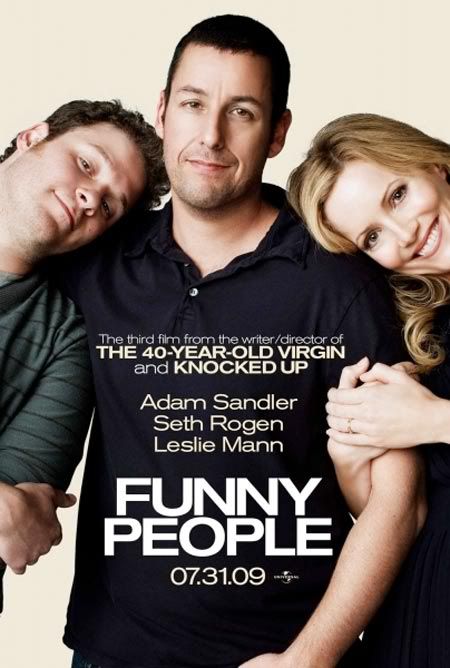
Judd Apatow returns for his 3rd writer/directorial expedition into comedic humanity. The thing about his latest feature, Funny People, is that there is surprisingly little that's actually funny about it. The material is likely his darkest to date.

Coupling with his former roomate and friend, Apatow deconstructs Adam Sandler's 15 year ascent to Hollywood success through the persona of George Simmons. It's good to see that Sandler has a sense of humor and self awareness to the endless slew of cinematic terribleness he's been unleashing on the public since the early 00's. Basically, Simmons is informed that he has a rare blood disease (a fictional form of leukemia, we're told) that may very well take his life. On a gloomily nostalgic trip to a comedy club, he is introduced to Ira Wright (Apatow regular, Seth Rogen.) Simmons takes the budding comedian under his wing as his new joke writer and sort of legacy-holder while he undergoes an experimental treatment.

For the first hour and a half, Apatow has spun a truly honest tale of our own mortality and the disassociative effects of long term fame. Simmons is portrayed as an almost soulless being, every scrap of true humanity stripped away by a lifestyle that's become too easy, while Ira is struggling desperately to break in to the lifestyle that's broken down Simmons. However, this in depth dissection is interrupted by an all but unnecessary 3rd act involving a now married former flame of George's that really only serves as a showcase for Judd's admittedly adorable, though narratively irrelevant daughters. This segment meanders on for a bit too long and only manages to further de-humanize Simmons, making him even less relatable or even remotely likable.

Sandler finally makes use of the talent most people had forgotten he actually has (last seen displayed in Paul Thomas Anderson's Punch-Drunk Love.) Seth Rogen shows more range than we've ever seen from him this time around. Paired with Jason Schwartzman and Jonah Hill as his fame-bound roommates, Rogen sells his morose ambition to a tee. Eric Bana (in an attempt to remind people that he was in something other than The Time Traveler's Wife this summer) goes out on a limb as the aussie husband to Leslie Mann (Apatow's real life wife and mother of his 2 soon-to-be starlet kids, playing the object of Simmons' misguided affections) and really hits some funny notes before anyone can notice that his scenes aren't very useful at all.

At the heart of Funny People is a good story. Unfortunately that good story is hidden inside the trappings of a self indulgent filmmaker that doesn't have anyone who's willing to tell him that a 35 minute tangent about an ex-fiance is a bad idea. The DVD will be worth the time, with the veritable goldmine of extras including uncut comedy performances, outtakes, alternate improvs and deleted material (I'd be surprised if there is any, the movie is so long as it is.) An unfortunate misfire for Apatow after the promise that Knocked Up showed, but even a not-so-great Judd Apatow movie is a pretty decent movie, overall.

Tuesday, August 18, 2009

Public Enemies


Michael Mann has had an overall impressive career. There have been the missteps along the way, like the over-inflated Ali and the nigh irrelevant revisiting of his 80's TV property Miami Vice, but movies like Heat, The Insider and Collateral maintain the balance. Now as the pioneer of the Digital Cinema age, Mann's Public Enemies ushers in the new era of filmic storytelling.

Enemies takes an interesting look at the life of John Dillinger. Instead of focusing on his rise to gangster infamy as the most renown bank robber this side of the Great Depression, we see the quieter portion of his downfall leading up to his assassination outside the Biograph Theater. Also interspersed through the tale is the birth of J. Edgar Hoover's Bureau of Investigation through the machinations of G-Man Melvin Purvis.

The way Mann has utilized the digital video technology is definitely unconventional. There are a number of scenes with sparse lighting that gives the image a grainy appearance, which at first appears to be amateur but slips into an almost documentary feel at times. And yet, Mann still proves that no one can film a gun fight quite like he can. He displays some of the most sleek and dynamic camera moves of his career during the bank heist and prison break scenes.

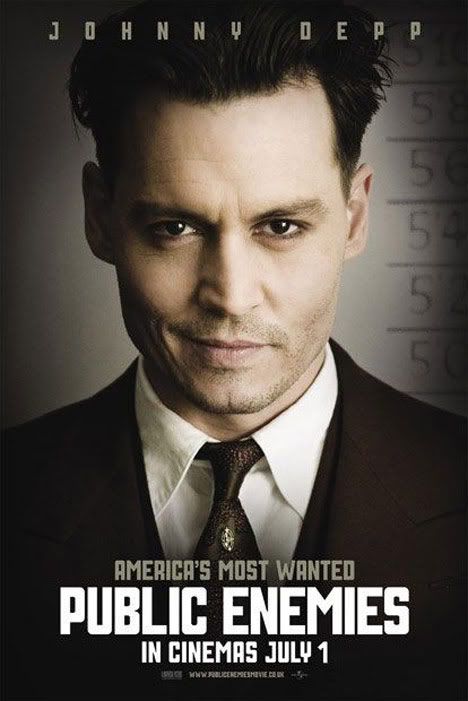
Depp's portrayal of Dillinger is one of his most understated performances in quite some time. While his physical likeness isn't necessarily uncanny, his mannerisms and overall persona convey such a staggering amount of charisma he sells himself to the role in spades. Christian Bale finally edges his way out of his gruff, gravelly voiced typecast as Melvin Purvis, which couldn't be further from his roles as either Batman or John Connor. He constructs an interesting anti-villain, while we're set to rooting for Dillinger for the most part, Purvis' transcends the typical "lawman" archetype, making himself sympathetic and noble at the same time. Those performances aside, the show is all but stolen by recent Oscar winner Marion Cotillard. Playing Dillinger's girl, Billie Frechette, Cotillard refuses to fall victim to the award winner's follow up film curse (see: Halle Barry.) The strength her character exudes, despite the gender role trappings of the era, is undeniably powerful.

Michael Mann only graces the big screen every 3 years or so. Public Enemies proves yet again that it's worth the trip to the theater when it happens.