Tuesday, May 26, 2009

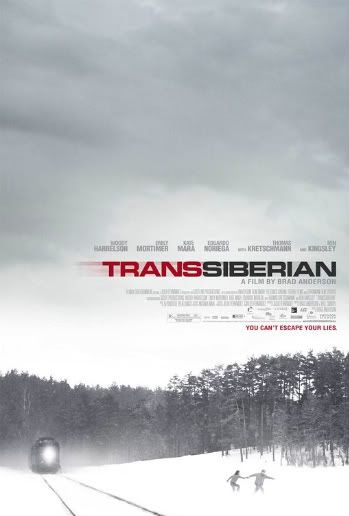
Transsiberian


It's fun to watch a director grow. One of the most promising filmic evolutions in modern cinema has been that of Brad Anderson. Not familiar with the name? It's not surprising as his three most notable feature films barely scraped by on a limited theatrical release (which is both astonishing and tragic, considering that material.) Even from Session 9 to The Machinist, his craft improved dramatically. After contributing two films to some TV projects (Masters of Horror and Fear Itself) he went on to direct several key episodes of Fringe (including the season 1 finale) and eventually wound up as a producer on the show. In the middle of all this, he somehow found the time to make the brilliantly understated thriller, Transsiberian.

Starring Emily Mortimer, Woody Harrelson and Ben Kingsley, Transsiberian is a testament to suspense. Brad Anderson has achieved levels of the genre that were previously only reachable by Alfred Hitchcock himself. The suspense is paramount in this picture, throughout. It achieves the highest levels of tension without ever resorting to excessive gore like the similarly themed Hostel films. The twists in the narrative are all organic and never feel trite or contrived. The onset of fear in the characters is entirely natural and believable so much so that the audience never doubts the choices made out of necessity of the situation. Anderson has become skillfully proficient in removing the "comfort zone" for an audience, which is integral when tackling the thriller genre. In Session 9, the setting of the dilapidated, dark and crumbling closed down mental institution did the trick, as did Christian Bale's emaciated figure in his follow up, The Machinist. Trannsiberian transcends his previous efforts by removing not one, but multiple comfort zones. Stripping them away from the protagonists, one by one until complete and utter hopelessness is imminent.

Though the true thematic core of Trannsiberian is honesty and truth. It's about the lies we tell our loved ones and the lies we tell ourselves just to get by from day to day. Emily Mortimer sells this idea almost perfectly. As an audience, we understand and sympathize with her need to lie, not out of spite or cruelty, but self preservation as she is the constant victim of circumstance as well as her own past personal demons. Woody Harrelson plays the supportive husband with a hint of a passive aggressive hero complex (manifested in the form of semi-altruistic Christianity,) a departure from most of the roles he's taken recently, but he executes it with style and ease. Ben Kingsley adds yet another nationality to his ever expanding repertoire as the Russian detective that's sniffing about the traveling couple (so far we've seen Kingsley chameleonize to Hindu, Middle Eastern, Brooklyn and Slavic to scratch the surface of his talent.) Also some markedly admirable performances by Eduardo Noriega (last year's lackluster Vantage Point and Abre Los Ojos, the Spanish original upon which the Cameron Crowe film Vanilla Sky is based) and up-and-comer Kate Mara (most notably seen in 24's fifth season) as the mysteriously friendly yet sketchy couple.

Trannsiberian is possibly the best thriller in the past five years. With Anderson's new and increased duties on Fringe (as he will be returning as producer for the 22 episode second season in the fall,) I hope he still finds the time to put together more theatrical work. Each of his projects to date has been exponentially better than the last and each one markedly different in vision and scope. As long as he remains out of the eye of the major studios, where creative tinkering is at its worst, we can look forward to more top of the line material from Brad Anderson.

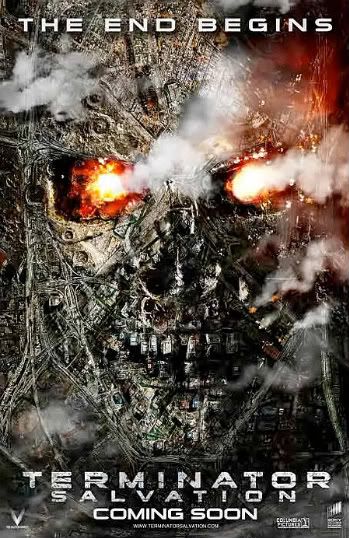
Terminator: Salvation

My love affair with Terminator began with the second installment. It hit theaters when I was about 10 or 11 and had not been permitted to see the first one (for obvious reasons, I was 4 when it hit theaters.) Taunted by the coming attractions, magazine covers boasting top of the line special effects and a theater run that outdid everything else that summer, I absolutely had to see it. Luckily, conceding to my pleas, my father took me to see T2 on my birthday that year. And so, Terminator became the summer fling that I always fondly remembered, by constantly forgot about.

Terminator: Salvation comes to us from questionable Hollywood director, Joseph McGinty Nichol (AKA McG.) I have trouble taking anyone seriously whose preferred nomenclature is not only a single name (i.e. Madonna, Cher, Seal,) but an abbreviation at that (see also: DMX.) This is also the person who gave us not one, but two Charlies Angels movies.

That being said, the movie looks good. The effects are top notch. The setting is dim, gritty and dark. Everything needed to create the Terminator experience that follows where the last Terminator experience left off is in the right place. However, the plot doesn't really make much sense.

We've jumped ahead 15 years since we last saw John Connor in Rise of the Machines (then played by the underappreciated Nick Stahl,) who has hence become a Batman-voiced soldier in the human resistance as well as a shadow-messiah to a select few that still believe he will redeem mankind from the clutches of the oppressive cybernetic organisms that bombed us halfway to hell and back in 2003. Problem is, the machines have an ace up their circuits. They're gunning for Connor's future/past father Kyle Reese (now only a teenager, played by Star Trek's Anton Yelchin in what might be the movie's best performance.)

Now, time travel is a tricky plot device and this is where the narrative gets sloppy. Given what we know from the past films, Future John Connor sends back an adult Kyle Reese (from the age difference, I'll say about 15 years after T:Salvation) to protect his mother Sarah in 1984. Reese and Sarah get cozy while hiding out and produce a baby John embryo. Reese dies at the hands of the first Arnold Terminator and Sarah destroys it. Lead in to T2. The only people with the knowledge of John Connor's paradoxical father is John himself (who I believe doesn't know him by name yet,) Sarah and the Good Arnold Terminator(GAT for short.) GAT is melted in the molten steel (as is the T-1000, who probably didn't have this information anyways, but for the sake of loose ends...) Assuming that the original Terminator somehow knew that Kyle and Sarah had shacked up and produced John, the chip that stored said information was also dissolved by Edward Furlong John Connor. Sarah Connor dies of leukemia somewhere between T2 and T3 leaving the John as the sole guardian of his familial secret.

History lesson over. Now, somehow all the machines in this post-apocalyptic world know who birthed John Connor and are gunning to have him erased from history (instead of just killing him like normal human-killing robots.) Added to the mix is unknown fugitive Marcus Wright (played by Sam Worthington who I've seen in absolutely nothing, but will be in James Cameron's crazy-future-scifi-epic Avatar) who, if you've seen any previews for this movie, is all or mostly robot. All this makes for about 2 full hours of chase scenes, shoot-outs, screaming matches and explosions. Everything you need for a summer blockbuster, though, as absurd as the plot to Terminator:Salvation is I can guarantee that it's going to be better than Transformers 2:Revenge of the Fallen.

The thing that worked for me about T4 was that it had echoes of previous installments scattered throughout. Every scene seemed like an updated or more futuristic version of an iconic moment in any one of it's three predecessors (and that's not including the recycled lines like "Come with me if you want to live.") Christian Bale functions as John Connor, but never really sells it. Honestly if he'd pulled more from his character in Reign of Fire it would've been better, though he is rather upstaged by Sam Worthington. As stated before, Anton Yelchin is probably the best actor in the film, easily. If the franchise takes off (despite mostly negative reviews) he'll be the one to make it worth the time. Bryce Dallas Howard is plainly underused, as is Moon Bloodgood, whose scenes border on significance but never really reach it. Common had absolutely no place in this film whatsoever. His lines (mostly delivered in ADR {Additional Dialogue Recording} while he's out of frame) are laughable and cheap.

While Terminator:Salvation didn't turn out to be the reinvigorating installment to the franchise they'd hoped for (in comparison to the staggering success of the Star Trek reboot,) we can only hope that McG and company (with new writers next go-round, let's hope) take a note from the page of George Lucas and make an attempt to fix the mistakes presented in this chapter. If not, we could see another proposed trilogy fall flat on it's face with Matrix-like proportions.

Friday, May 8, 2009

Dollhouse - Season One


WARNING: This season recap/assessment will contain some major spoilers for the entirety of Dollhouse's 12 Episode run.

It was late in the throes of the 2007-2008 WGA/AMPTP Strike that sci-fi guru Joss Whedon (Buffy the Vampire Slayer, Firefly/Serenity) announced that he would be reteaming with BtVS alum Eliza Dushku to create a new series for broadcast television. On the outside this sounds like a brilliant prospect, however there was a catch. He'd be helming the project on FOX, the same network that gave Firefly a snowball's chance in hell when it premiered back in 2002. Despite the bad vibes on the initial outset of the project, it seemed Whedon had another ace up his sleeve. While the strike was going full steam, an independent internet exclusive project was conceived with friends, series alums and family. That project was Dr. Horrible's Sing-a-Long Blog, which evidently blew the top off of the internet when it premiered in mid July.

Then the bad news started to filter in, sometime in early fall. The internet promos for the show had just started to pop up on FOX's website when it was revealed that FOX was not a fan of the pilot episode Whedon had produced for the series. The episode, entitled "Echo," was ultimately scrapped (though I've read a draft of the original script and cannot wait to see it and the yet unaired 13th episode "Epitaph One" on the full season DVD that's due out this July) and key elements were cannibalized and put to use in the newly structured early season episodes. This is about when the "Save Dollhouse" campaigns started up. A full 6 months before the new pilot episode (now entitled "Ghost") hit the airwaves. Another punch to the gut arrived when it was announced that the series would air on Friday nights at 9pm. Otherwise known as the "Death Slot" in TV terms.

So the bloggers blogged and the nay-sayers continued to nay-say and the premiere date approached rapidly. February 13th (yes, Friday the 13th, ominous) arrived and "Ghost" premiered. I'll have to say, it was better than a great deal of other television shows on the air at the time and DID contain a fair amount of Whedonism to it, but it also had the stink of network intervention all over it. The first five episodes really only held a handful of series mythology about them though they did assist in laying the groundwork for the final seven episodes where it became blatantly obvious that Whedon regained full control of his pet-project.

The premise for Dollhouse is not simple and is honestly a little off-putting at first glance. The Dollhouse is an underground organization that commissions "volunteers" to have their memories completely erased so that they can be uploaded with a new set of memories and skill-sets to carry out "engagements" with high paying clients. Between "engagements" the "Actives," as they're referred to, exist in the Dollhouse's facility as blank slates. They have no emotion and no personality whatsoever. Eliza Dushku plays Echo (all the Actives are named after the NATO military alphabet, other regularly featured actives include Sierra, Victor and November,) who starts off the series in the early stages of her 5 year contract with the Dollhouse. Within the first 5 episodes (which played like "engagement of the week" television) it becomes clear that Echo is somehow maintaining small bits of each downloaded personality. Along with Echo's glitching brain is FBI agent Paul Ballard who is determined to expose the Dollhouse despite not having anyone even believe it exists, let alone help him bring it down. There's also the resident Dollhouse Boogeyman, otherwise known as the rogue Active named Alpha, who murdered several Actives and Staffers before he was supposedly "killed." Though he manages to shake things up early in the season from behind the scenes before making his grand re-entrance at season's end.

The season seemed to make a full U-turn at episode six, "Man on the Street," which was written by Joss Whedon himself. It shook up the previous format of "engagement of the week" and focused more on Ballard's solo-investigation of the Dollhouse and explored the morally gray organization that IS The Dollhouse. Who pays for this service and ultimately WHY they pay for it. It was also revealed this episode (after a killer fight between an imprinted Echo and Paul Ballard) that there was a mole in the Dollhouse willing to help Paul, as long as he doesn't get himself killed sticking his nose too far where it doesn't belong.

From this episode forward, we were delivered heavy doses of mythology, character development and ultimately, Alpha's return (played by Whedon's Firefly alum, Alan Tudyk.) The theme for the season (and possibly the series, should it get renewed or not... fingers crossed) is, are the memories that make us up all that we are? Are our minds and bodies one or separate? Should one lose the other are we not still the same person, or just the empty shell of that person? In short, the existence of the soul, or the ultimate act of self-realization. Based on the chilling final moments of the 12th episode (entitled "Omega,") the human spirit will overcome the obstacles that are placed in front of it, despite that which makes up the person being forcefully taken away.

Unfortunately from the outset, Dollhouse found itself in a ratings spiral. It's live audience dwindled as the weeks progressed (though the Nielsen rating system is so outdated, it pains me to think that it's still being used successfully) though it's DVR/TiVo bump and hits on Hulu have been substantial enough to point out a niche audience that's developed. The initial lead in my dying-on-its-feet series Terminator: The Sarah Connor Chronicles didn't seem to do Dollhouse any favors and after that ended as abruptly as it began, the death-rattle episodes of canceled series Prison Break seemed to eradicate any carry-over viewers that might've been. FOX announces their 2009-2010 schedule on May 18th and the odds are stacked against Joss Whedon and company. Through a small miracle, there may yet be another season of Dollhouse (the first season is available for pre-order on Amazon.com, releasing on July 28th) and the crew is remaining hopeful.

UPDATE 5-16-09: While FOX will unveil this on 5-18, Dollhouse has been picked up for 13 more episodes in the fall. Welcome, Season 2!

Thursday, May 7, 2009

Star Trek


I'll start this off by listing some things I know about Star Trek. Chekov pronounces the word "missile" like "wessel." Vulcans have pointy ears. Klingons are bad (except for Worf.) Tribbles are all fur. The Next Generation was pretty good for a long time. Enterprise was not. In short. I really know next to nothing about Star Trek in it's 40-some odd year existence in pop-culture, enough to get the in-jokes on Futurama, but that's about it. The thing is, I've never really felt compelled to get to know Star Trek. It's the kid in school that you knew you had things in common with, but the nagging feeling that there was enough contrast in your shared commonality to disuade from actually gearing up a conversation. And it never gave me a reason to BE compelled.

That is, until it was announced that the series was to be rebooted by none other than Geek-Media Guru, J.J. Abrams.

I've been a fan of Abrams' work since just before the second season of Lost hit the airwaves. Hell, I even enjoyed Mission: Impossible III (despite the presence of a certain Scientologist that will remain named Tom Cruise,) but taking on a property that I'd had no prior relationship with seemed intriguing. Re-teaming with his Alias alums and current Fringe show-runners Alex Kurtzman and Roberto Orci (who were also responsible for the disastrous Transformers movie at the hands of pompous actioneer Michael Bay,) and casting relative unknowns in the lead roles, the new Trek seemed to be a mixed bag before any actual footage was even released. My skepticism was proven wrong at the release of the first trailer and again after seeing the film in it's entirety. This movie is awesome. Plain and simple and I'll go as far as to say that it's better than The Wrath of Khan, and THAT's saying something.

Now, this is far from both your typical Star Trek film and franchise reboot (Batman Begins, Casino Royale to name the good ones.) The script functions in a way that allows us to see the beginnings of James T. Kirk's command of Starship Enterprise without overwriting the tales that preceded when William Shatner was still sporting the mustard yellow StarFleet Captain's tunic. Which is to say, it doesn't steamroll the canon of the original series (television or film.) The core plot essentially involves the formation of the classic enterprise crew through the vengeful machinations of Romulan enemy, Nero (played by a nearly unrecognizable, Eric Bana.) Each crew member is given their character defining moment, with more emphasis on Kirk and Spock (naturally, as they are the focal point of the series with vastly deeper motivations in this new chapter.)

The casting was impressive, pulling in relatively unknown actors with fairly impressive resumes to boot. Newcomer Chris Pine delivers an angstier version of Kirk, as a "wrong side of the tracks" kid who makes good in the Star Fleet, whether they'd like him to or not. Heroes alum Zachary Quinto is a dead ringer for Spock with his silly bowl haircut and upturned eyebrows (which was funny in light of his typical "Sylar" uni-brow.) Zoe Saldana takes on Uhura who manages to transcend the title of lowly "communications officer." Anton Yelchin is a young Pavel Chekov, complete with silly accent, and Simon Pegg (of Shaun of the Dead and Hot Fuzz fame) returns to the arms of an Abrams project (we last say them together on M:I3) as Montgomery "Scotty" Scott and John Cho (Harold of Harold and Kumar) plays a pretty convincing Sulu (and not just because he's Asian... However, my favorite character in the ensemble was Karl Urban's Leonard "Bones" McCoy. While not as crotchety as DeForest Kelley, Urban gives "Bones" an air of hypochondrial pragmatism, which makes for a certain type of cynical comic relief at times.

One of the major detractors from the original series for me had always been the static space battle sequences that always took place on the bridge of the Enterprise. Kirk shouts "Fire the proton torpedoes," everyone stares, someone shouts out "Incoming," the entire room shakes and a few people fall down. Granted, this format of space action is still present in the new Trek, but the way it's written, blocked and directed it seems much more dire and immersive than it was in previous incarnations. The inner layout of the Enterprise is still as confusing as ever, though as large a scale vessel as it's supposed to be, I'm not sure the navigability is of the highest priority. Turn right at the red corridor and enter the big double sliding doors to get to the bridge. Done. Next scene.

Beaming technology is given a slightly more advanced explanation or at least a more technical approach beyond the traditional "Beam me up, Scotty" as well as an updated special effects treatment. There's also a fair amount of off-ship action too, and Abrams has both the scope and the budget to make it look nothing short of awesome (the skydiving and atmospheric platform fight come to mind.) Last but not least, Nero's Romulan ship design was unrequited amounts of awesome.

I truly hope this paves the way for more chapters in this new era of Star Trek and if J.J. and company are involved, even better. There's a shortage of decent "Space Sci-Fi" out there these days and it makes me feel good to see someone do it right for a change (I'm NOT looking at you, George Lucas!) And before you step onto the Starship's Molecular Transporter, you might want to re-think that red shirt you're wearing...

Wednesday, April 29, 2009

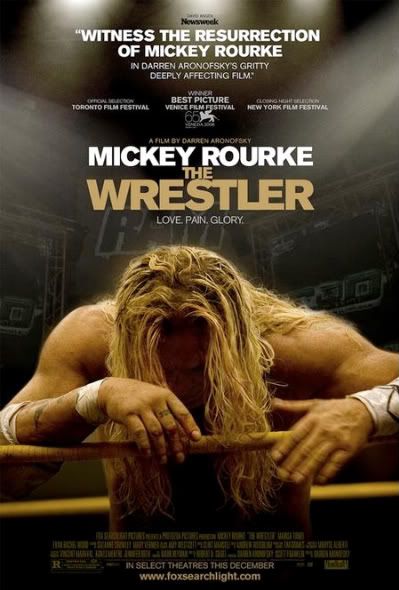
The Wrestler


Though Darren Aronofsky's career hasn't been that of commercial successes, his short but powerful resume has mustered a hefty amount of critical acclaim. Beginning with the quirky math-thriller Pi and his painfully honest adaptation of Hubert Selby Jr's novel Requiem for a Dream. After a long and troubled production on his 3rd film, the fantasy parable The Fountain, which was ultimately panned by critics, Aronofsky stepped back to the small scale character drama The Wrestler featuring the comeback of former Hollywood heartthrob turned hulking behemoth, Mickey Rourke.

Adorned with flowing blond locks and about 35 extra pounds of muscle-mass, Rourke re-emerges on the big screen (small screen if you missed the theatrical release like me) as the washed up pro-wrestler Randy "The Ram" Robinson. We only get a glimpse of his former glory in the opening credits, awash with main event posters set to the various over-enthusiastic announcers and Quiet Riot's "Bang Your Head" (which also doubles as The Ram's entrance music in later scenes,) but any pro-wrestler that has his own action figure (sadly displayed on the dash of his beat up van) and Nintendo Game representation was a big deal in his glory days.

Aronofsky's work is no stranger to personal tragedy and "The Ram" is no exception. Immediately following the credits we're greeted with a "20 Years Later" title matched with a shot of Rourke sitting in a locker room with his back to us. And the sadness begins. The tale of Randy "The Ram" Robinson is that of a man who never created a coping mechanism for the real world, having spent the majority of his adult life in the pro-wrestling circuit (so we're led to believe) in front of the camera as an entertainer. In essense, he's a horse put out to pasture with no intention of dying on someone elses terms. Trying desperately to hang on to who he once was by partaking in small circuit matches and conventions on the weekends, a day job is seemingly out of the question. Though maintaining said lifestyle (heavy training, enhancement drugs, booze and strippers) without the benefit of the big WWE bucks presents a challange in and of itself. And then his heart gives out.

A large portion of the film (including the first 10 minutes of so before we even see Randy's face) is shot handheld, following behind the character. It wasn't until a key moment that I realized exactly what the purpose was. Having seen a handful of WWE shows on television, the camera will follow a given opponent through the green-rooms and back hallways on their way to a match. This aspect of Randy's former lifestyle was seamlessly applied to his everyday life, adding more weight to the tragic narrative that is The Ballad of Randy "The Ram" Robinson.

Of course all the "Resurrection of Mickey Rourke" talk is completely true. Since he re-emerged from his bare-knuckle boxing days looking less Rocky Balboa more Rocky Dennis, he's knocked out a few roles here and there (the most memorable being the oafish hard-luck Marv from Sin City, less so was his hard-ass mercenary from Domino) but nothing with the dramatic weight that he displays in The Wrestler. It's one thing to be able to spout one-liners and act thuggish, but it's another kind of talent to make an audience feel sympathy for someone who, at the end of the day, really deserves none. Marisa Tomei reins in a performance infinitely more deserving of the Oscar she claimed back in '93 (granted the competition was tighter this year) and Evan Rachel Wood pulls off some of the most heart-wrenching verbal fights I've seen onscreen in recent years (granted I haven't seen Revolutionary Road yet.) Stepping the realism up a few more notches are the actual indie-circuit wrestlers that make up "The Ram's" opponents throughout the story, some of the stunts (staples, barbed wire, hidden razors for impromptu bleeding in the ring) I am still not certain were "effects" or not.

After seeing this (and subsequently seeing it performed live not long ago,) I think it's an outright travesty that Bruce Springsteen's song of the same title as the film wasn't even nominated for an award by the Academy this year. I mean, I'm glad Slumdog Millionaire swept the way it did, but this song is nothing short of epic. And it's The Boss. I mean, come on.

Darren Aronofsky has proven himself to be not just a good filmmaker, but an exceptional one. In a way, I almost prefer that he maintains his footing on the edge of the mainstream industry, shepherding in new talent the likes of Rian Johnson (Brick and the upcoming Brothers Bloom) and Brad Anderson (The Machinist and Transiberian.) With four wildly diverse films under his belt, I'm eagerly anticipating whatever comes next in Mr. Aronofsky's expanding resume.

Sunday, April 19, 2009

Crank: High Voltage


WARNING: EXPLICIT LANGUAGE CONTAINED IN THE FOLLOWING REVIEW...

Ok. Since the movie in question is hands down the most ridiculous thing I've seen onscreen since Shoot 'Em Up (and Crank 1 before that,) I'm going to dispense with the formalities and make this review as crass as the movie itself. Also... Spoiler Warning. Just putting it out there.

Holy shit! You knew after seeing the end of Crank that somehow, some way they'd bring back errant bad ass, Jason Statham, for a follow up, and boy did they ever deliver. The answer? Robot Heart. That's right. They gave Chev fuckin' Chelios a goddamn robot heart.

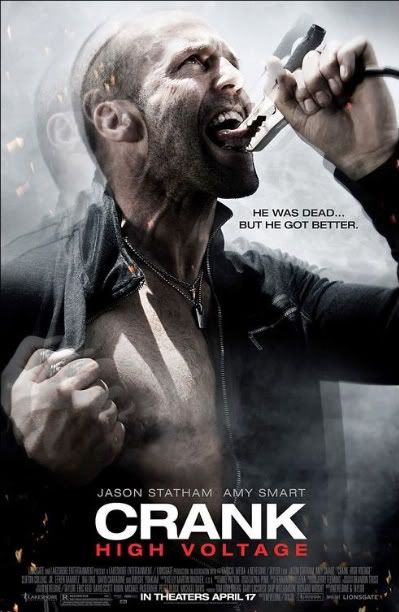
Now the premise of Crank was that his bloodstream was toxified with an agent that required him to maintain a constant release of adrenaline. This made for all kinds of absurd behavior, ranging from racial slurs in a gang bar to coke snorting all the way to sex in public. This time, with said robot heart dependent on an electrical charge every... let's say five minutes (as it were in the movie, at least) this allows for even more absurd behavior, ranging from (but not limited to) jumper-cables on the nipple and tongue (see complementary poster above...) tazers, car cigarette lighters and yet another foray into PDA.

So far, the Crank series is the stupidest set of movies I'm not afraid to admit I absolutely love. It's probably because the movie is operating on a level of self-awareness that most actioneers should be striving for (take notes Michael Bay...) Crank 2 doesn't just wink at the camera, it laughs at it and outright gives it the finger (literally.) Most of what goes on in Crank 2 happens, quite simply, because it can. Godzilla homage? Sure. Genital mutilation? Why not.

Predecessor alums Amy Smart, Dwight Yoakam and Efren Ramirez return for the craziness (and honestly, who wouldn't?) while adding some new (yet familiar) faces including Clifton Collins Jr. (Capote,) Corey Haim (rehab), and Bai Ling (who is eccentric enough as it is, when added to the Crank recipe, is all but unbearably obnoxious.) Not to mention a slew of pseudo-celebrity cameos (David Carradine, Geri Halliwell and Lloyd Kaufman among others) that you'll likely not even notice unless you scour the imdb.com page.

Though, for me, one of the higher points of praise for Crank: High Voltage was the score by none other than alternative-noise rock-savant, Mike Patton. Less influenced by his tenure in Faith No More and more by projects like Mr. Bungle and his solo material, the accompanying soundtrack compliments the frenetic attitude the film sets out on within the first 10 seconds. What ensues is the audible equivilent of a schizophrenic's crack nightmare that takes place at a circus freakshow from hell. You'll know what I'm talking about when you hear it.

Crank: High Voltage is not to be taken seriously. It exists simply because it can and succeeds at pushing the envelope as far as it can go, and then gives it one last shove off the cliff (or out of the plane, if we're taking the first film into consideration.)

Monday, April 13, 2009

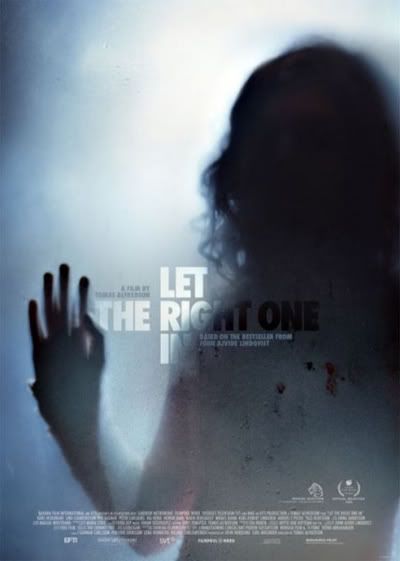
Let the Right One In


From every critic and friend I know that's seen this movie, they've all said about the same thing. "This is probably the best horror movie I've seen this year." Whether they're referring to 2008 or 2009, it's still a valid statement. And, yes, it was unnecessarily cock-blocked for a nomination in Best Foreign Film by the Academy. It's movies like this and The Strangers that remind me what it is I love about horror movies. You can assault my visual senses with gore and violence all you want, but you'll be hard pressed to actually scare me with any of it. The creepy-factor comes from atmosphere and tone (see also, The Strangers, Session 9, Jacob's Ladder, etc.) Something that makes me feel as uncomfortable as the characters do.

Let the Right One In is a Swedish film based on a book of the same nationality and title (soon to be remade here in the states, and we all know how those end up, so don't get me started...) With the unfortunate timing to be released the same year as the trainwreck of a blockbuster Twilight, Let the Right One In almost serves as the soon-to-be franchises evil (read: cooler) twin. Both involve vampires (Twilight uses the term vampire as loosely as can allow,) a feeling of loneliness and a forbidden love. The major difference is that the latter of the two actually manages to succeed at all three. So let's just forget that Twilight doesn't exist for the duration of the review, shall we?

The subtlety of Let the Right One In is what makes it effectively scary. A major sin in the American horror industry is that spectacles of violence and gore are amped up and overblown with flashy close ups and anticipatory swells in the accompanying musical score. LtROI doesn't rely on such visual trickery to be effective. The fact that the despicable acts are treated as equally to the rest of the film (and at times underplayed) make them harder to stomach, comparatively. The gore and violence is far from excessive, which actually makes it feel that much more disturbing when it does come up.

Almost immediately after the DVD release, there were complaints and rants circulating the internet regarding the English subtitles for the US release being abbreviated and "dumbed down." I've seen the comparisons and there is a substantial chunk that was omitted (for no other reason, assuming, than to cater to a DVD audience that doesn't like reading,) though having seen the edited subs, it really doesn't affect the overall experience of the film. While the dialog IS an important aspect of any movie, Let the Right One In relies more on tone in the end.

Sadly, with any successful overseas genre piece, Hollywood has already bought the rights to the source material (novel) and greenlit the American remake, which will no doubt age the characters up to acceptable social standards and spell out every implied nuance in the story. Before this (expected) attrocity hits the theaters (in a wider release than it's predecessor,) do yourself a favor and see the Swedish version.